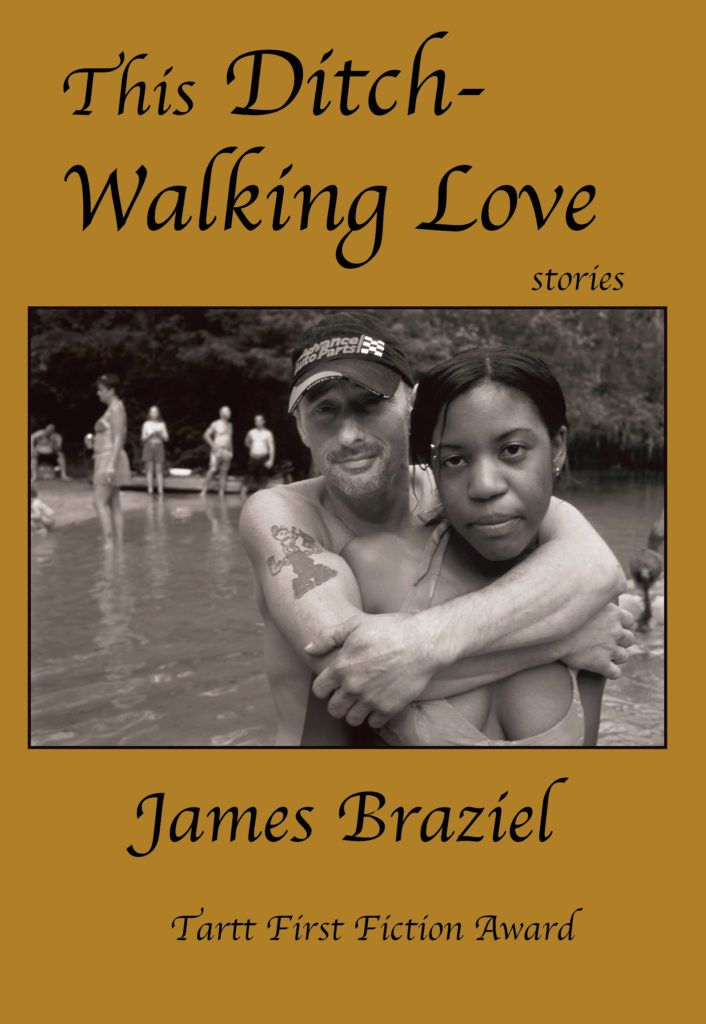
This Ditch-Walking Love (Livingston Press, 2021) is a collection of stories set in the Murphrees Valley section of the Cumberland Plateau where ridges lift above what creeks and small rivers have made. No matter where you dig, shovels and rockbars hit chert, causing the ground to spark. That difficulty of breaking the land is heard in the way people speak here. It is rural and hilly here. Ravines spill into creeks that feed into the Locust Fork River. A chicken plant is the biggest employer. People work there or on farms, in the local schools, stores, churches, and the church of Walmart.
Because the characters in Ditch-Walking don’t have enough money to carry them, they rely on a network of plateau fields, creeks, woods, and clay roads. It might be enough, a field row in August for walking and gathering tomatoes and okra up, or a bluff for jumping off of into the Fork, or a drive out to Jick’s Chevrolet just to see his hellfire cars. These are the places everyone goes to, looking for what they can’t make full on their own.
The stories in Ditch-Walking are first person accounts—two brothers searching for the dead body of a friend, a passerby happening upon a lynching, a daughter plotting against her grieving mother, and a nephew who finds a Ferris wheel instead of arrowheads buried on Brown’s land.
I’ve always written for the people I worked with in the watermelon and cantaloupe fields of South Georgia where I grew up, people defined by sweat and work and lots of laughter because laughter was the only counter you had for dealing with what was hard in your life. Their voices have given me my voice as a writer. My hope has been to give them stories in return, stories they could take part in. The people I’ve gotten to know on the Cumberland Plateau are not so distant. These stories are for them and for you.
Here is a review of Ditch-Walking from the Alabama Writers’ Forum—